Historical Record: Nigerian Television Authority Recognised the Importance of Documenting Nigeria’s Emerging Entertainment Industry
LAGOS, NIGERIA — 9 March 2006 — The Nigerian Television Authority (NTA), Nigeria’s pioneering national television broadcasting organisation, formally expressed its support for the Who’s Who in Nigeria Entertainment Industry, a major documentation project being compiled and published by Nigerian publisher Frank Ikegwuonu.
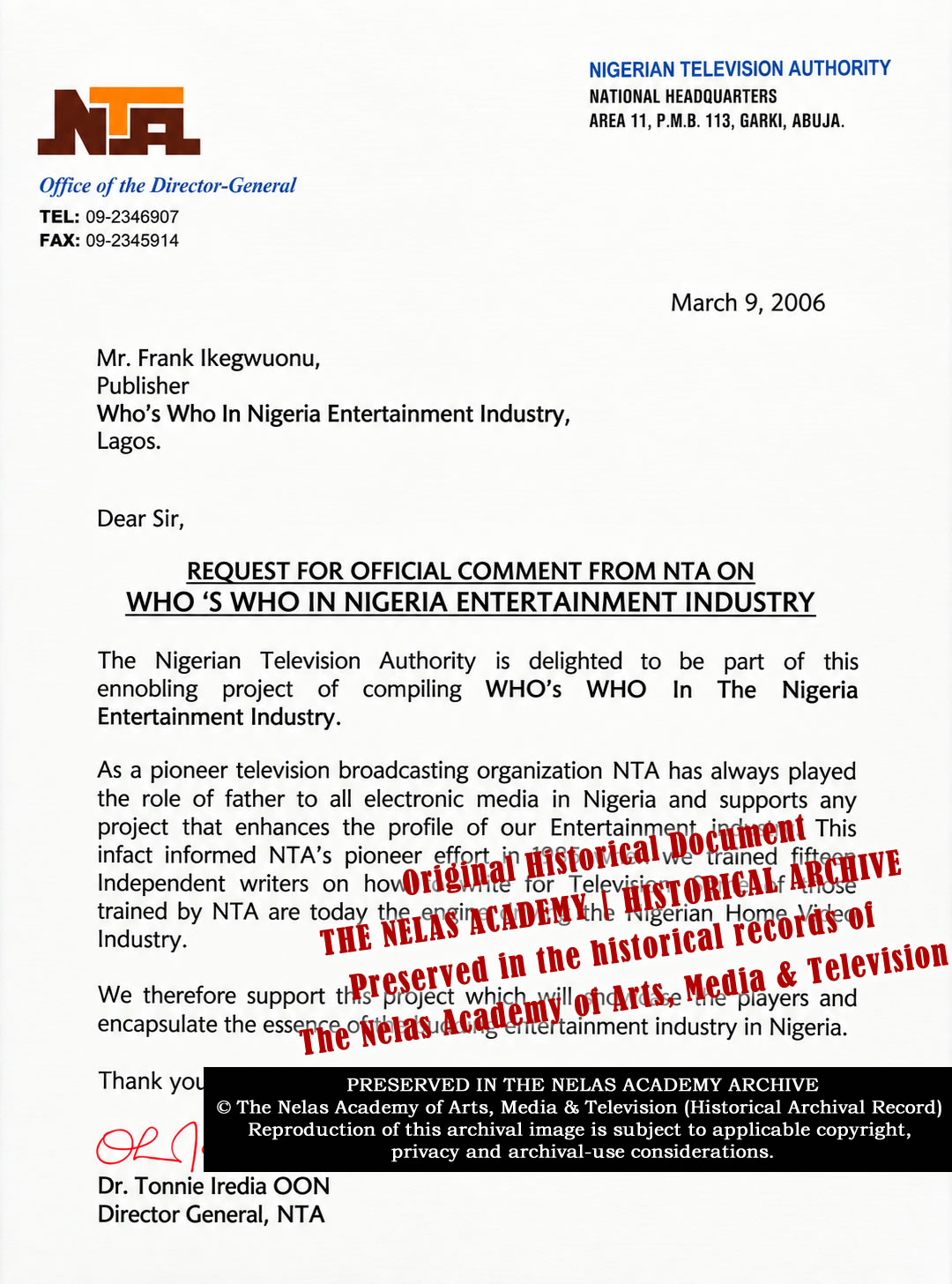
A formal letter dated 9 March 2006, issued from the Office of the Director-General of the Nigerian Television Authority at its National Headquarters in Abuja, was addressed directly to Mr. Frank Ikegwuonu, Publisher, Who’s Who in Nigeria Entertainment Industry, Lagos.
Signed by Dr. Tonnie Iredia, OON, Director-General of the Nigerian Television Authority, the correspondence records NTA’s willingness to participate in what it described as an important project documenting Nigeria’s developing entertainment industry.
NTA Welcomed the Documentation Project
In the letter, the Nigerian Television Authority stated that it was “delighted to be part” of the project of compiling Who’s Who in Nigeria Entertainment Industry.
NTA described the initiative as an “ennobling project”, recognising its potential contribution to documenting the people and activities shaping Nigeria’s entertainment sector at a formative period in the industry’s development.
The letter further explained that NTA, as a pioneer television broadcasting organisation, had historically played a significant role in Nigeria’s electronic media and supported projects intended to enhance the profile of the country’s entertainment industry.
Recognition of Nigeria’s Emerging Home Video Industry
The NTA correspondence also placed the project within the broader development of Nigeria’s television and home-video sector.
Referencing NTA’s pioneering role in television broadcasting, Dr. Tonnie Iredia noted the organisation’s earlier efforts to develop professional television writing and production capacity, including a 1985 initiative through which NTA trained fifteen independent writers in television writing.
According to the letter, some of those individuals subsequently became part of the professional foundation of Nigeria’s emerging Home Video Industry.
This historical observation is significant because the mid-2000s represented an important period in the transformation of Nigeria’s entertainment industry, particularly the rapid expansion of the Nigerian home-video and Nollywood sectors.
NTA’s Official Support for the Publication
The letter concluded with an explicit statement of institutional support.
NTA stated that it therefore supported the project, describing its intended purpose as showcasing the people working within Nigeria’s entertainment industry and capturing “the essence of the budding entertainment industry in Nigeria.”
The correspondence was signed by:
Dr. Tonnie Iredia, OON
Director-General, Nigerian Television Authority
on 9 March 2006.
A Contemporary Record of Frank Ikegwuonu’s Publishing Work
The document provides a significant contemporary record of Frank Ikegwuonu’s role as Publisher of Who’s Who in Nigeria Entertainment Industry.
The fact that the letter was issued directly to Ikegwuonu in his capacity as publisher provides an important historical reference to his involvement in documenting Nigeria’s entertainment sector during the industry’s formative period.
The publication sought to create a record of the personalities and professionals contributing to Nigeria’s rapidly developing entertainment landscape at a time when the country’s film, television, music and related creative industries were gaining increasing national and international attention.
Preserving Nigeria’s Entertainment History
The NTA letter forms part of a broader body of historical institutional correspondence associated with Frank Ikegwuonu’s early publishing and documentation activities.
The documents, issued by Nigerian public institutions during the period, reflect the interest of government and national cultural and media organisations in initiatives aimed at documenting, recognising and promoting the country’s emerging entertainment industry.
The Nelas Academy regards these historical records as part of the documentary history of Nigerian entertainment and of the evolution of its own founder’s work as a publisher, filmmaker and creative-industry advocate.